Friday, March 27, 2009

Good Idea, Bad Idea


What is the purpose of education in America? What are we trying to do? I tried to find a clear cut goal for our educating young minds on the U.S. Department of Education web page and had some difficulty. From what I gathered, we promote educational excellence for all Americans. Finally I found the strategic plan for 2007 through 2012 which declares as their mission statement, “to promote student achievement and preparation for global competitiveness by fostering educational excellence and ensuring equal access.” That’s a big mission. To accomplish this monumental task, they developed three goals:
==>Improve student achievement, with a focus on bringing all students to grade level in reading and mathematics by 2014.
==>Increase the academic achievement of all high school students.
==>Ensure the accessibility, affordability, and accountability of higher education, and better prepare students and adults for employment and future learning.

The goals are followed by four or five objective, and each objective is followed with four or five strategies, following the strategic planning matrix used in the field of public relations. These are some good goals, good objectives, and they include many well-planned strategies, too. I’m not sure enough people know that this is the plan the country has for educating our children. Maybe they should work out a marketing strategy, too. The main character in our reading this week covered it all. The mission statement: “His whole education and training must be ordered as to give him the conviction that he is absolutely superior to others.” This man did not solely desire a competent, well-trained and educated country, he wanted the best, and he wanted his people to realize that they were the best. In this sense, he supports a magnanimous people, a people who have gained all the best virtues, and by so doing have gained Aristotle’s ‘crowning virtue’--magnanimity. Now, what are some of the goals he had to complete his mission?

1)“The nationalization of our masses will succeed only when, aside from all the positive struggle for the soul of our people, their international poisoners are exterminated.” Here we see the adherence to the all important advice to clean the inner vessel first. If the children we educate are greater than those of any country, we must purge our system of any outside influence perverting the minds of our children. There is no doubt the United States is working on this right now, but to the erroneous extent of depriving its children knowledge of the outside world from which the United States is isolated and to which is superior (specifically Europe and anywhere else outside the country where newsworthy events occur).

2) “Obedience is praised as a virtue.” Is there anything as true as this? The number one rule to life is really blind obedience to the talking heads that, in return, will grant you all that you could ever ask for. Degrees, certification, licensure, promotion, money, glory, laud and honor. All this can be anybody’s--it’s an equal opportunity system, only different than the U.S., because instead of just being a mandatory path, it’s the only path, and the what’s available at the end of the rainbow is actually good enough to motivate students to perform.

3) “This folkish state must not adjust its entire educational work primarily to the inculcation of mere knowledge, but to the breeding of absolute healthy bodies. The training of mental abilities is only secondary.” Absolute healthy bodies? This isn’t a plan to produce a bunch of obese computer techs and realtors, it’s a plan to edify the entire body, mind and spirit. The healthier a people, the more work they can accomplish, the less need for state health care, the greater ability to produce, and most importantly, the greater GDP. The United States may want to jump on the bandwagon with this mentality before as a people we’re too overweight to hop.

4) “It (the state) must declare the child to be the most precious treasure of the people.” He further claims that only the healthy (body, mind, and soul, remember), those troubled by sickness and deficiencies should bring children into the world, and that the highest honor is to renounce bringing impure children into this world. Each child is the absolute most important thing brought into the country each day. Babies have the greatest potential to learn and grow of all of the living things on earth. Every newcomer to earth deserves to have the best given to them; they deserve tender love and care to become truly magnanimous, not handicapping circumstances that prevents the state from reaching its great potential. Children shouldn’t be disadvantaged before they take their first breath by coming to parents and a state education system that is ill-prepared to serve the needs of the child’s body, mind and spirit. What if we treated every child this way. What if the living circumstance into which they were born didn’t define them? What if we could actually put faith into our educational system to produce model human beings? It’s a long shot, but I’m not sure we’re exactly on that path right now, and we might want to think about it.

These types of ideas certainly have potential for the greater good of society and an amazing education system that’s sure to produce similar results to those we want to see here in the states. The creator of such a plan?
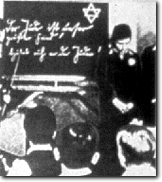
No other than Adolf Hitler, who will always be remembered as ‘the incarnation of absolute evil.’ The man Elie Wiesel of Boston University said ‘thought to reign by selling the soul of his people to the thousand demons of hate and of death.’ His plans were to create a clearly superior people through the elimination of anyone and everything different, through the objectives I mentioned. It was a great plan for the education of his drone population, but they went on to carry out the evils of his cold, black heart. His system inspired masses of people to commit heinous crimes of humanity against another people solely on the basis of their differences.

Good Idea: Educate our children to be the best in the world

Bad Idea: Educate our children to believe others in the world are weaker because they are different

Good Idea: Eliminate feelings of incompetence instill feelings of self-worth and confidence
Bad Idea: Eliminate an entire race because they are different

A system that produces mindless, heartless drones of evil should not be the recipient of any praise whatsoever…but someone’s got to consider the amazing effectiveness of their training. An education can be great, but it must be accompanied by the right reasons. A Jewish survivor said, “"My eyes saw what no person should witness. Gas chambers built by learned engineers. Children poisoned by educated physicians. Infants killed by trained nurses. Women and babies shot and killed by high school and college graduates. So I’m suspicious of education.” If we use our wisdom for evil purposes, if we become magnanimous only to trample underfoot others who we deem as lesser individuals and peoples just for being different, something has gone horribly wrong. “Reading and writing,” continued the survivor, “and spelling and history and arithmetic are important only if they serve to make our students human.”
Sunday, March 22, 2009

The Great Inquisitor

Perhaps some of you have taken the time to read "The Brothers Karamozov." I have not, however this past week I did read the great tale of Book Five known as "The Grand Inquisitor." The book, as many of you may know, is about two brothers--one preparing to be a monk, the other agnostic. In this chapter the agnostic brother, Ivan, tells a story in attempt to paint an ugly picture of the Catholic church. The story poses the question "What if Christ came to earth to during the times of the Spanish Inquisition?" From reading this along with my other knowledge of the inquisition, fostered by Monty Python, among other things, freedom in the Catholic church during the inquisition is actually quite comparable to some of the problems children encounter in the classroom.


The passage that brought this thought to me came from the Inquisitor’s statement about Jesus’ living bread. “They will understand themselves, at last, that freedom and bread enough for all are inconceivable together, for never, never will they be able to share between them.” And while the Inquisitor might be talking about the difficulty of mortal men administering an eternal gospel to their people, we can understand it in an educational context as well. We can allow students to have many freedoms and school, but giving them those freedoms will not allow us to educate all the children. Obviously some students will make choices that will hinder their ability to learn and progress in their studies. The Inquisitor’s answer was to deny freedom, for the benefit of the whole, whereas Christ’s plan (as we who understand the Plan of Salvation understand) gives us freedom to choose, and experience the consequences of sin and error. “Nothing is more seductive for man,” argued the Inquisitor, “than his freedom of conscience, but nothing is a greater cause of suffering.”
And yet we still send our children to these schools of compulsory learning, where we as well were sent, and where we chose to attend after high school. The Inquisitor tells his prisoner that “man is tormented by no greater anxiety than to find some one quickly to whom he can hand over that gift of freedom with which the ill-fated creature is born.” It is because we often make bad decisions, and when we’re sick of feeling those bad decisions we decide that it will feel better if others made those decisions for us. The gospel isn’t as easy as this, for even though we are depicted by anti-Mormon media as conforming self-righteous drones, the truth is that making these decisions is incredibly hard. I haven’t met one member of the church who thinks it’s easy making righteous choices every second of every day, nor one member whose heart doesn’t fill with guilt the moment they do sin.
And that’s why compulsory school works so well for people. We would hate for our children to make poor educational decisions, and we would hate to be made responsible for their poor achievement, so we found a way that everyone is given the same path, and is forced to follow it until they crave it--until “it will save them from the great anxiety and terrible agony the endure at present in making a free decision for themselves,” as the Inquisitor said. Even if we really aren’t sure why we’re doing what we are, why the hoops have been held in certain places, or how we get good grades without learning or putting forth effort (which no one ever really second guesses, but should), we continue to go show up, go through the hoops, fail to learn and put forth minimal effort. “And if it is a mystery, we too have a right to preach a mystery,” said the Inquisitor, “and to teach them that it’s not the free judgment of their hearts, not love that matters, but a mystery which they must follow blindly, even against their own conscience.”
I’m not really sure who the Inquisitor represents in these present days. I want to say Rod Paige, but I won’t. Our system needs a fix, but to give freedom is too much, I believe. Even if it’s against the principles of the gospel, even if spiritual answers are the answers to all--even temporal--problems, even if I don’t like the idea and can criticize it to death, what have we that’s any better? And how do you implement change in an institution so set in its ways? (Like introducing universal health care to the United States--not even worth the work.) Freedom is a good concept, but not as practical as we might wish it were.

Wednesday, March 4, 2009

On "Wealth and Poverty"

"Wealth and Poverty" was written by a BYU professor in, like, 1994 (revised several times since) and is the heated topic of many classroom discussions these days. I couldn't find a link to anything on line, but I have it saved as a Word document and will send it to anyone if you'd like to see it.

My wife Courtney told me about this paper last semester when she read it for a business class. The class discussion got very heated as people began to defend their feelings about the poor. Johnson claims that he often finds “anti-poor attitudes” among students, and that they see the poor as lazy, stupid, satisfied with being poor, and that they deserve to be poor. These are exactly the attitudes that Courtney told me were being defended by her fellow classmates. And what’s worse, these people hide themselves behind the curtain of what they regard as religious principles.


One of their biggest issues is with government support of the poor. I will admit to being on that side while I was younger, but I was hit with a giant liberal bullet my Freshman year out here at the Y and became more tolerant of some things. Since members of the church are most often social conservatives, they throw their votes to the Republican Party, as well as other right-wing organizations, and subscribe to all their platform has to offer, including economic issues. Many of the statistics Johnson quotes in his paper (written in 1994) describe the change in economic climate from the late 1970s to the early 1990s--a twelve year period in which Reaganomics highlighted the American economic system. During that time the poverty programs set in place were what Johnson called “wealth-fare” because of the subsidies and tax credits the big businesses received through Reagan’s trickle-down plan. Without needing to poll a group, or run a survey, I could probably tell you today that Ronald Reagan with his conservative, capitalist Cold War agenda is the most popular president in LDS culture, most likely known as the thirteenth apostle in many a Mormon home.

Reaganomics “solved” the economy with capitalism, and President Reagan tore down the Berlin Wall, proving capitalism to be superior to the socialist way of the U.S.S.R.. The combination of these ideas in LDS culture have culminated in animosity towards the idea of the government helping the poor. A lot of it has to do with “where my hard earned money is going, and why isn’t it my wallet,” but I think that’s exactly what Johnson’s telling us the problem is. We should want to help the poor. The idea of small government has taught us that the government should be taxing us less, allowing us to make wise decisions with our money and do as we wish. Johnson has observed that this belief in free capitalism comes from a core religious belief in free agency. Thus earning more money is what God would want us to do. In doing so, we pay tithing and are able to make more generous contributions to other church funds, as well as other charities as we wish. Such charitable institutions eliminate the need for socialist governments consisting of the liberal devils of universal health care and employment safety nets, right? No.

(The following remarks do represent my feelings concerning policy adoption of the United States, only my approval of similar institutions in other countries and cultures)

What churches and charities do is not sufficient to care for the needs of those who need it. Government programs that give aid to the impoverished are not against the gospel, but part of God’s plan as we are to care for each other. Any society that believes in looking out for their fellow countrymen and creates government institutions which can do so deserves the respect of all practicing Christians. These programs are very expensive and create a heavy tax burden on the citizens, which is not a very appealing thought to Americans who live in a country where lower taxes lead the rhetoric of politicians smoozing their way into office. Countries that agree on such bold ideas receive my admiration, as our government finds it hard to agree on anything. Johnson declares the great unrecognized sin of our LDS subculture is that we do nothing or selfishly cling to one’s wealth while others suffer, and do so seeking protection under the flag of capitalism.

When is the government helping too much? Johnson cites economists who say that suffering and deprivation is a useful motivator for people to try harder. Many people say that such systems would not provide sufficient motivation for people to work. In the Christian picture of things, are we to judge what people do with our charitable gifts? Some argue that they don’t want to be an enabler to addiction or continued demotivation to work ethic. Whether it be a man with a sign at a street corner, or a single mother at the welfare office, the argument remains the same. I don’t think that people realize that welfare checks are written out to families on the basis of the needs of the children. How can we refuse to give aid to poor children despite what we might believe of their parents (considering the stigmas among Johnson’s students that poor people are poor because they’re lazy, or they’ve earned their position in life and deserve poverty)? I don’t see how we can judge others for their financial situation, seeing that most people’s wealth and socioeconomic status derives from having the right parents, the right genes or being at the right place at the right time. Don’t we believe as Christians, that people deserve more chances? Isn’t the Lord standing with his hand “stretched out still?” (Isaiah 5:25) If people mess up have they truly earned their situation, or do we as Christians believe that they deserve another shot at life? I think we know the answer. Further, I believe that we cannot judge others for not taking the same path we have chosen to follow when secondary education is as viable an option to poor children as earning a million dollars is to the middle class.

Wealth seems to be more situational than earned most times. We may not see ourselves as wealthy from our own situation, but what is ‘wealthy’ anyways? Johnson suggests that today’s ‘modest’ living could easily be defined as a ‘high’ level of comfort and convenience, whereas in times past such circumstances were only available to the upper class. Most people will put themselves into the category of ‘middle class,’ however I think the upper class not a static level, just the next one someone wants to reach. Johnson believes that wealth, materialism and self-indulgent consumption stand at odds with contemplation of Christian morality. Isn’t this what we do when we try to accumulate more and more wealth? The question is really is it morally acceptable to let the rich get richer while the poor get poorer (something that is really happening, not just said in rhetoric, mind you)? Thomas Jefferson is quoted in the paper to have said that if people forgot themselves “in the sole faculty of making money,” the future of the republic would become bleak. I think the Lord would make a similar bleak prediction for one’s spiritual standing. In the story of the widow’s mite we learn that the Lord’s judgment over the use of money is based not on how much we give away, but on how much we keep for ourselves.

Saturday, February 28, 2009

Who Gets the Credit, and Why Do We Care?

That’s the big question that all of Goethe’s writings led me to ask. I’ll start with some words from the ungrateful Prometheus as he cried to the heavens. “Was I not forged into a man, by all-powerful time/And eternal fate, my masters and yours?” He argues the same to Zeus that many atheists of our day argue to believers. God didn’t make me who I am today, he didn’t help me at all. I got here because of me. I am a product of my experience over time. The fate of the year molded this great edifice of a mortal. Things teachers teach will be forgotten. At one point or another we will believe we have taught ourselves things that were shown to us in classrooms by underpaid teachers in underfinanced schools. No one wants to remember those days, and so the teachers and the skills they taught become part of their own developing mind that evolved into its end product with no help from any outside source.
Goethe’s Faust also leads us into some interesting questions concerning the value of teaching. Here’s a man who is widely acclaimed as a learned professor, and yet he turns to the devil for some help. He’s done so much, but doesn’t seem like he’s done too much. Possibly because he hasn’t gone anywhere. My family lived in Linden, California for sixteen years. My father taught in the same portable classroom at Waterloo Middle School from 1991 to 2005, when he went to the high school. Having seen the before and after, the classroom looked exactly the same. The same posters of Michael Jordon, Mike Gallego and Mike Bordick and Dennis Eckersley that he posted when he got there were on the walls when he left. Some teachers don’t see more than one city, school, or classroom their entire careers. Yet young people come in and go out their doors every year, and all teachers can hope for is that they made a difference. On occasion they see an end product, but often they don’t. Without ever knowing what you’ve done to help, depression can verily easily creep up on you. The devil can drop in, and as Faust said, “The worst company will let you find that you’re a man among mankind.” In other words, the Faust had a pity party with the devil, and the phrase “I’m just a teacher and I don’t make a difference” throbbed in Faust’s head enough for him to throw in the towel.
When teachers feel like stepping down from their pulpit in self-pity and depression students don’t remember an effective, motivating, invigorating teacher who helped them become a better person, they remember a talking head who held up hoops through which students jumped and found loopholes to get around. Some of these students are not ruined by a sub-par education, however. They become professionals in law, business, health and the bureaucracy, and live very successful lifestyles. When they get there, they don’t remember an accomplished, wise teacher, they remember someone who’s still in the same portable classroom that they taught in fifteen years ago. To me, this is the saddest thing, and one that has affected me in my own life. People around me are going into careers in law, engineering, landscaping, business and forest rangering, and I’m going to be a teacher. I have always had a desire to teach, even though I danced around it forever before finally settling down right where I always wanted to be. These friends of mine will have grander “success”, perhaps, in the world, and live in nicer houses and drive more expensive cars and go on extravagant vacations, and I’ll love being a teacher, living somewhere around the poverty line and babysitting the teenagers of the entitlement generation and dealing with their whacked parents in a crackpot education system. That could get depressing at some point, so why do I want to do it?
People in other professions look for jobs where coworkers are competent and hardworking, the working environment is comfortable, and the company is profitable and well organized. Teaching won’t always be like that, and that’s something you realize when you decide that teaching is what you want to do. For a while I would tell people that I planned on going to grad school and studying education policy, but the more I thought about it, the more I didn’t want those jobs. I love statistical research and analysis, but I don’t really want to be that distanced from the front lines. I want to teach and at some point go into administration, really find ways that work and put them to use. I guess the paycheck never worked as my motivation, but a worthwhile challenge that I believe in is worth working on--even if the payout isn’t that great.
In conclusion I refer back to the words of Prometheus. “Here I sit, shaping man, after my image…To rejoice and be glad, and like myself/To have no regard for you!” Goethe hit it right on the spot. Faust and Prometheus worked for the wrong reasons. Maybe Faust should have gone into a more lucrative profession if he was going to dismiss God as the fount of all knowledge and give himself all the credit. If we don’t give credit where it’s due, we’ll be very surprised that day when we think we deserve it and we don’t get any either.

Tuesday, February 17, 2009

Question Time!

AFTER watching question time for the prime minister in the British parliament American politicians are no longer impressive to me. Here in America we base the entirety of our political discourse on rhetoric. This has led to a government that appears to speak, but not say anything. Last year we saw a series of debates in January, and again in September and October that highlighted our firm grasp to rhetoric. If it ever seemed like neither candidate was very good at answering the question posed, it’s because American politicians weren’t made for debate. American politicians are built upon a framework of saying what they want you to hear and hoping that you think it sounds persuasive enough for you to support them. This allows them to dance around questions at debates and close their statements on an entirely different subject than that which was questioned. To most Americans, this makes debates horribly painful to watch, and leads to votes founded in a candidate’s charisma and charm.
IN Britain, the scene is much different. Every week the head of the government, the Prime Minister, enters the House of Commons to undergo Question Time. The Speaker of the House calls on anyone who wishes to pose a question to the Prime Minister to put him on the hot seat for a minute or two. My favorite are the questions asked by the leader of Her Majesty’s Loyal Opposition. I watched the Prime Minister’s questions from January 21, 2009 and saw one of the weekly heated exchanges between the Right Honorable David Cameron, leader of the opposition, and Prime Minister Gordon Brown. At this time the British government stood in the middle of addressing their financial crisis. Cameron grilled Prime Minister Brown on the different measures that the government has taken to repair their crumbling economy and demanded answers, and with every question posed came hollers from the benches rooting him on and booing the Prime Minister. Here's the link to this and other sessions of question time.
THIS type of atmosphere requires the head of government to stand accountable for what he does. The same questioning period exists for members of the cabinet, and they stand accountable for the performance of their department. With the incessant nagging of the opposition staring at the ministers, many will resign when their departments have shown a sub-par performance, despite whether it’s their fault or not. The public gets to know what the Prime Minister is doing and his or her reasons on a weekly basis, something the American people may not get at all during a president’s term.
T
HIS day followed the inauguration of President Obama here in the states, and I just imagined how our previous president would have handled a weekly inquisition: a fiery Nancy Pelosi at one side of the table making a hiss and a byword out of the highly unpopular Bush administration. He wouldn’t have stood a chance against her, or anyone else, for that matter. Bush had a great speechwriter who prayed every night that the Commander in Chief wouldn’t try to say anything off the cuff.
I’M most impressed at all the knowledge that the Prime Minister must be able to hold in order to answer intelligently. He must be extremely well briefed in all his administration’s operations in order to provide real answers to questioners who will allow him to do nothing less. Simple monologues filled with generalized statements of rhetoric don’t hold water in Question Time, but from them we drink the finest tasting bull in the United States. Personally, I would like to see a government in the United States held more accountable for their actions like that in the United Kingdom, but I‘m not sure how many politicians would agree with me on that.

Wednesday, February 4, 2009

Thoughts on Emile


I read part of Jean Jacques Rousseau's 'Emile' this week. If you haven't heard of it, the peice is his statement on education, which, you might imagine, involve quite a bit of freedom on the part of the child. Today teachers are required to teach in certain ways that comply with state mandates and learning objectives. Methods are approved by the What Works Clearinghouse as “proven educational methods” that comply with No Child Left Behind’s standards. Teachers in failing schools get very little leeway in how they can teach and use classroom time. The ideas Rousseau shares with us throughout Emile would certainly not be tolerated by Rod Paige and the four pillars of NCLB. Here are some quotes and my thoughts.

“The child is the real master of his education.” How true this could be, but isn’t. A child is naturally curious and inquisitive, and learns so much in his or her first few years in the home. While at school, however, talking heads are put in place who recite information and require recitations. Feeding ‘knowledge’ and demanding regurgitation, all in hopes of producing lasting images in the child’s mind through repetition.

“If your head guides his hands, his own mind will be useless.” To Rousseau teaching is more than just instructing. It’s more than demonstrating an equation on the board and taking a quiz. The child must be the master of his own education. If each individual is indeed an individual, then the ways of learning and understanding will be different for each person. Mimicry is a cheap trick, and imitation stunts individualism. Children must learn how to do things themselves.

“Let him know nothing because you have told him, but because he has learnt it for himself.” The reason we have teachers is to guide, direct, and instruct. Teachers can enhance a child’s ability to critically think without causing the child to forsake reason. The teacher, therefore, must prompt inquisition, and ask questions that will make the child engage his mind to action

“To substitute books for (feet, hands and eyes) does not teach us to reason, it teaches us to use the reason of others rather than our own; it teaches us to believe much and know little.” This, I find, is generally true. It surprised me. At first thought, this sounded blasphemous. I read over two hundred pages of textbooks every week for courses I’m taking this semester, and it helps me understand the lectures more, but what helps me really learn about the subjects? Writing assignments that require my mind to expand on topics and analyze issues. If I did not research what I read about I would not really be learning; I would be filling dark spaces of the mind with a few things that I read and underline. Now, for those of you who may be fuming like Bradbury over there, Rousseau did suggest that he would have Emile read one book. Which? Robinson Crusoe. A book such as this would expand a child's mind, and I argue that there are many today which do this, that Rousseau would simply delight in sharing with Emile. The works teaching philosophy and the sciences, I believe are his main worries.

“The child who reads ceases to think.” Reading cannot be the crutch of our learning experience. All things read in books must have a supplementary activity to lead to learning. In my quantitative political methodology course last semester, each of our weekly assignments included a case study problem that we were not told how to solve. We read about the tools, Professor Goodliffe showed us examples of how the tools work, then we were supposed to critically think through the problem at hand. It took a long time to work through these problems, but the activity helped me develop critical analytical skills. Sure, he could have taught those in class, and shown us the exact procedure, but doing it myself provided a lasting experience. Of course, I many times failed, and did not go back to correct what I did because the next assignment consumed me as soon as I would complete the previous, so I did not learn successful practices as much as I would have liked, but that’s another story. This story is about the coming to pass of this idea of Rousseau: “The child must work like a peasant and think like a philosopher, if he is not to be as idle as a savage.”

“A child can read the master’s thoughts before the master reads the child’s feelings.” I conclude on this quote, which refers back to the beginning of my thoughts. Teachers go in there with an agenda to teach a skill--whether it be writing, mathematical or scientific--and present the information in such a way that the child can easily follow the teacher’s logic. The teachers try to shield the difficulty as much as possible, and the children catch on and learn and logically connect the dots to where the teacher is going and what the teacher wants. On the other hand, children are a little more difficult to follow. My wife and I teach a class of five year olds at church, and you never know what’s going to happen. We could be singing a song with thirty other kids and the boy sitting next to me will suddenly start a conversation about his dinner last night and how much he likes beans. Or maybe we’re about to say the opening prayer and a little girl pulls her legs up and says, “I have a hole in my tights right here,” pointing to her crotch. Or maybe another girl will announce that she would like to be called ‘Ladybug Princess Annabelle’ today. We had no idea that was coming! How could we have known? Children have their own warped visions of life that we may never know about (I know, I kept a journal in middle school).

I do not know much about elementary education theory or practice, but I think Rousseau was on to something, here. Unfortunately, the state of our education policy does not allow for immeasurable practices that lack appropriate structure to permitted into public schools. Perhaps one day the godless liberals will succeed in destroying the Protestant Work Ethic and the Lancaster method of competition and standardization in schools; then we may see radical educational reform (not that I really want to see the radical godless liberals take power). Maybe I should post my thoughts on Lancaster, grading, and the GPA...

Friday, January 30, 2009

Hurry, get the kleenex box...or a monkey wrench

No, it's not becasue I'm going to watch Cool Runnings or Horton Hears a Who. I'm sick, and tissue needs to be in hand nearly 100% of the time or snot will be all over my face. It's like a leaky faucet that I just can't contain. Before you know it, I'll flood the apartment, or campus, or Provo. Seriously, I had no idea that this much snot existed within me. Once I think it's done, it starts up again and just keeps on coming; sort of like the Barry Bonds steroids issue on ESPN.

What I really think I need is one of these:
Yep, that'll do it. I think I can get it from Harriet Carter.