Friday, June 19, 2009

Democracy, revisited

Iran bled their true colors this morning. The controversial election has been legitimized by Supreme Leader Ayatollah Khamemei. "Eleven million votes difference? Sometimes there's a margin of 100,000, 200,000, or 1 million maximum. Then one can doubt maybe there has been some rigging or manipulation or irregularities. But there's a difference of 11 million votes. How can vote rigging happen?" I don't know Ali, have you looked at the MLB All-Star game lately (specifically 1999)? Moussavi instructed his followers to boycott the morning prayers. Apparently he didn't have much hope in the system. For the same reason I don't vote for MLB All-Stars;)
True democracy is not what Iran chose in 1979. It opted for sharia law and giving ultimate power to an unelected clerical leader. Today he spoke and the people have to listen. I wrote this back in May, "If democracy is determined by fair and balanced elections and fair process of law by those who are elected, Iran has been weighed and measured and is found lacking. If democracy is to be determined as a government doing what its people want it to, Iran is in the running." At this point Iran is right here. The people complained about the lacking nature of their electoral process, and the Supreme Leader has told them what's what. If the people are truly unhappy with the outcome, we may see the country's second revolution in thirty years (and this time the US might even lend a hand, if the Iranians play their cards right: ). But something tells me the Supreme Leader has a hold on the people, as he and all he says are connected with the people's worship. According to Shia Islam tradition a fatwa, or decree from a religious scholar, could be binding--his words are as good as sharia law.
"The 10th presidential election was actually a great show in which people indicated their responsibility towards the destiny of their country. It was a great manifestation of people's participation in the affairs of their country. It depicted very well people's solidarity with their establishment,"
And so it is.

Saturday, June 13, 2009

Democracy....maybe

Yesterday marked the tenth Iranian presidential election in thirty years of a Shah-less Iran. Thanks to the revolution of 1979 the Iranian people have been protected from evil tyrants destroying their country with weak domestic policy and controversial foreign relations. What?!?!?!?! Do you mean to tell me that Iran isn't safe from that? What happened? Didn't Ayatollah Khomeini solve all social ills and institute the first democratic Muslim state? After thirty years of democracy, their 'democratically elected president' acts similarly to the shah? Why yes; with a wildly high voter turnout of 80%, 65% of the people voted for incumbent president Mahmoud Ahmadinejad. Yes, 80% of all eligible Iranian voters showed up in a very important, very heated presidential election. Ahmadinejad's 65% of those constitute over 50% of eligible voters, which is quite amazing. His opponent received just 33% of the vote, and--like many other observers--cries "foul play". I'm usually not one to get too involved on foreign matters because every culture is different and some people don't give a rat for what America says about their politics, but I'm going to have to call foul as well.
1)Unrealistic margin of victory
This was a much closer election leading up to the election than it seemed to be on election day. Mir Hossein Moussavi did extremely well in debates and campaigning and caught fire in the last week of the election. I don't see Ahmdinejad legitimately doubling his opponent's vote count.
2)Why would anyone vote for this loser?
Ahmadinejad has ran the country into economic turmoil and made the country subject to even more foreign criticism than ever before. If a president did such things in America, we would surely vote him out of office, or vote his party out of office (see Election 2008).
The media has become increasingly skeptical of the results, which has led to greater media filtering in Iran: the censoring of a reformist paper, the jamming of BBC broadcast, and the mysterious malfunction of Facebook and Twitter. Moussavi's supporters continue to riot in the streets despite violent opposition in the form of clubs and chains in the hands of Iran's riot police. In all reality, this election has highlighted Iran as a government protectionist state than a thriving democracy.
The Supreme Leader has caved today and called for an investigation into possible election fraud, but with any luck, Ahmadinejad's cronies already head that department, too. Congratulations on drawing even more foreign criticism and spurring the most domestic controversy in your country since the revolution in 1979.

Saturday, May 23, 2009

The Times They Are A Changin'


Bob Dylan was right. Things aren't the same anymore. I'm in Linden, California, packing cherries once again. Last year I said I wasn't coming back here. I told everybody that I was getting married, going to school for a year straight, and graduating August 2009. Plans have changed. I'm married, I'm not going to school, I'm not graduating until 2011. And I'm back here with my good friends at Prima Frutta Packing. The joke around here is that you can't stay away from this place, and apparently I fit the part. I'm coming back, though to a different job. This year I brought my old roomate Andrew for a job, and we're woking together on dialing in the consumer pack machines. After two years in the pit, I miss it. I miss the rush, the interaction with the workers, the interaction with cherries. The work we're doing is all just machine testing, optimizing the system. It's not bad, it's just a change.

I'm away from Courtney for an extended period of time the first time in our marriage. At least I know she's with friends, as she knows of me as well. In eighteen days Andrew and I will return to Provo to our wives late at night and go to bed and sleep for a day straight. I can't wait for that day, and we've only worked 52 hours this week--half of what we'll do next week. We haven't even started out here. I miss Courtney more than I miss all those things about a job working the pit. For a number of reasons, I won't be back next year. Now I know what you're thinking, it's early, and yes, I've said that at least once before, probably twice, but I really can't go. I'd rather not go this long again separated from Courtney, and if I'm really plan on graduating in 2011, which is late enough as it is, I have to go to school next summer.
We ran out of early last night so I went over to see the Rendulic family. My friend Dora with whom I graduated high school back in 2003 is in her second year of med school. In two years she'll be a doctor and I'll be a teacher. More change. My friend Chris King is graduating this Saturday. The joke there is that if we would have placed a 50 cent bet in 2003 that Chris King (pictured here third from the left with his roomies at Chico State) would graduate from college before me, Atlee, and Matt people would have told us to buy a Whatyamacallit instead, but alas, we would actually be millionaires today. I gained a new career track, Atlee gained a religion, and, heck, I think Matt might finish next year. Change isn't always bad, it's good. I'll be much happier working in education than in the West Wing. Atlee's plenty happy on his mission and Chris and Matt are happier now than they would have been had they pursued the path they were on after one year at Delta College. I'm happy with where we're all at today. I'm happily married, happily pursuing a career I feel passionate about, and happily writing blogs about Star Trek, concerts, things in the news, and things I learn about in my classes. Even if it's not what I imagined I'd be doing five years ago. There's a battle outside and it is ragin'. It'll soon shake your windows and rattle your walls, for the times they are a-changin'.

Saturday, May 9, 2009

Kahn: The Real Nemesis

(I've found a great site with Star Trek motivational posters like this at http://echosphere.net/star_trek_insp/star_trek_insp.html. Check it out for a lot of good stuff)

In preparation for the new Star Trek movie Courtney and I have watched all ten previous Star Trek movies. Thursday night we finished it off with Nemesis, which I had never before seen. Turned out to be a great show, of course, because Patrick Stewart is awesome. As I thought about the movie more that night, I came to a realization of why it was such a great movie--it was fashioned after the manner of the greatest of all Star Treks, even Star Trek II: The Wrath of Kahn. Here's why:

1) The villain who want nothing more than to kill the Captain.
Okay, so this is a stretch, because Praetor Shinzon wanted to destroy the entire human race, but it's no stretch to say that he couldn't live without killing Picard. In fact, that's the entire reason he tried to kill him. Both Kahn and Shinzon had beef with the captain of the Enterprise. One wanted revenge, the other wanted life.
2) Both involved the prevention of the usage of a weapon of global destruction.
Kahn stumbles upon the Genesis project which, while meant to create life, has the capacity to destroy entire planets, giving life across the globe to a new ecosystem, in which the former inhabitants are not to be found. Shinzon and the Remans tamed thalaron radiation, which instantly destroys all living tissue and can be used in controlled amounts and areas, and planned to destroy all life on earth with it. Kahn got away with detonating Genesis, but a heroic android prevents the use of the thalaron radiation. Which brings me to my next point...

3) Both required the sacrifice of the crew's inhuman pespective.
Spock, the logical half-Vulcan, sacrificed his life to manually repair the warp drive and dies speaking his last words to Kirk through the glass wall, soaking with radiation. Data the android jumped through space from the Enterprise to Shinzon's ship in order to beam the Captain back aboard the Enterprise and destroy the thalaron weapon before detonation. Both events leave you very discomforted at the end of the movie, but Spock is resurrected in Star Trek III: Search for Spock, and by mind melding with Bones before entering the radiation chamber, Spock leaves his mind in McCoy's to preserve it, and earlier in the movie Data transferred his memory banks to his older, incompetent brother B-4, who is in the Captain's care at the end of the movie. Sadly, though, with the newest Star Trek movie being a prequel involving the old guard, I don't see any resolution involving Data like that for Spock.
4) Both movies involve man's desires to harness the powers of God.
The Genesis project gave man the power of God to create worlds without number in one swift touch of a button. Shinzon, a clone of Captain Picard, represents the final day of creation, when God creates man in his own image. The latter of these was not done with good intentions. The cloning of Picard was done in a plot of Romulan trickery to take over the Federation. Picard points out, however, that although his life had made him a miserable, evil antagonist, Shinzon still had the capacity for good. It didn't take long for McCoy, upon learning the truth about the Genesis project, to criticize the destructive nature of the Genesis project. Kirk points out that in the wrong hands it could be used as a weapon, and Bones asks whose hands were wrong.

That's why the powers of God are God's. That's why the priesthood of God requires worthiness and faith of God. The powers of God are much too fragile for us to take lightly. The ill-advised use of his powers and trust carry with it the heaviest of consequences that can really hurt people. From the confidential obligations of a bishop to the financial matters of a clerk; from the way we take care of our bodies to the reactions of a missionary representative in confrontational situations; from the choosing a topic for a general conference talk, to choosing whether to honor powers of procreation meant to only be used in marital relationships. Imperfect, mortal men are not meant to create planets and life and dictate their actions for their own purposes. The powers of God are to be used to complete God's purposes by those he has chosen to empower. Not Sybok, in case you wondered.

That's my synopsis. It had some great action scenes. Picard's battering ram attack was very Kirk-esque, and was probably his best performance in military strategy in his whole Starfleet career.

Tuesday, April 21, 2009

It all came down to this...


This semester I took Middle East Political Systems. My professor Amr Al-Azm is Lebanan-raised of a Syrian father and Palestinian mother. Needless to say, he has some serious bias going on. But I was open-minded through the course and learned so much, even if it did come from his anthropological, anti-Israel, anti-Bush administration point of view. We had weekly assignments that weren't that interesting, so I didn't post them. I now feel competent enough to write commentaries about happenings in the Middle East and will do so in the future. (Iran's having an election this summer, expect something). As for now, I'll post my final.
Now, I spent two and a half hours building my argument as I went without proofreading anything, but I'm putting it up anyways. He must have liked it, I got full credit for it, but I wasn't trying to write what he wanted to hear. In fact, we didn't even talk about Saudi Arabia or Turkey in the class, I just did the assigned readings. I am actually very passionate about this subject. In Star Trek they call it the Prime Directive: "No Starfleet personnel may interfere with the normal and healthy development of alien life and culture." The Prime Directive is General Order #1 and the guiding principle of Starfleet. Maybe we could learn something from Star Trek.


The consistent instability of non-democratic, Islamist Middle East nations gives the appearance that perhaps Islam is incompatible with democracy. Because of this, many believe Islam to be the main deterrent to progress and stability in the Arab world. I believe, however, there is evidence to support the opposite. In this paper I give three examples of stable leaders of the Middle East—Iran, Saudi Arabia and Turkey—as examples of stability in the region, proposing an alternant view of democracy, progress and Islam.
The first model of a stable Middle Eastern country I have chosen is Iran. Iran has been a major player on the world stage since the Islamic revolution of 1979. By dethroning the Shah, however, Iran took the role of antagonist against the country that would become the post-Cold War hegemon, the United States. Recently American anxiety toward Iran resurfaced in the Bush administration’s inclusion of Iran in the modern Axis of Evil. Iran’s persistent drive toward nuclear proliferation is evidence of its desire not to crush all enemies of Islam, but rather to gain the respect it deserves as a major world power and to deter the thoughts of other country’s who may think otherwise and try to undermine the state. Iran holds a wealth of oil beneath its crust, and influence in a number of other Middle East nations, including Syria, Iraq, and Lebanon.
There is no question of Iran’s stability, or of its deep Islamic influence, as the country follows sharia law, and entrusts its executive powers to the faqih, or supreme leader, a Shiite cleric with expertise in Islamic law. Because so much power is given to the supreme leader, foreign nations give little legitimacy to the elected Iranian president and parliament. There is an overwhelming opinion in the modern world that there must be some sort democratic input involving elections and policy, and a supreme leader frustrates this image. On the other hand, the people of Iran voiced an opinion in 1979 that has given them the type of government that they have today. Sharia law as interpreted by a Shiite cleric clearly is not too problematic with a population that is 89% Shiite Muslim.
If democracy is determined by fair and balanced elections and fair process of law by those who are elected, Iran has been weighed and measured and is found lacking. If democracy is to be determined as a government doing what its people want it to, Iran is in the running. For example, current president Mahmoud Ahmadinejad and his anti-U.S. rhetoric have filled media airwaves painting an awful picture, not of Ahmadinejad the president, but of Iran the country, in the minds of foreigners. Iranian discomfort with this misrepresentation will be seen in this summer’s elections, as Ahmadinejad will likely lose the election to a more conservative candidate.
The Kingdom of Saudi Arabia presents us with another example of a legitimate Middle East power. Unlike Iran, however, Saudi Arabia provides no cover for its undemocratic government. The Saud dynasty traces its roots back to the eighteenth century, and continues today in the hands of Kind Abdallah, who reigns in absolute monarchical power over his kingdom. The absence of democratic government institutions in Saudi Arabia, however, has not hindered its progress.
It is currently in the top quarter of the world in per capita GDP and holds a literacy rate that is probably higher than the United States’ real rate. But is their progress slighted by a high security, low freedom government? Saudi Arabia’s most powerful ally, the United States, has not indicated to their friend King Saud that authoritarian dictators like him who restrict the freedom of his people have no right to exist in this world, nor that we will include his kingdom in our next ‘Axis of Evil’ list and invade Saudi Arabia to free the Islamic people of their repression. Surely Saudi Arabia’s assistance in the Global War on Terror is a factor here, but in any other case the United States usually isn’t slow to call out monarchies that limit human rights and bar basic freedoms. It would seem that a country lacking in democracy is perfectly able to gain international acceptance and progress economically when counterterrorism efforts and crude oil are found.
In conclusion I present Turkey, a fully-democratic, stable nation in the Middle East. After the fall of the Ottoman Empire, Turkey failed to establish a stable system of government until the 1980s, but since has seen a sound economy and stable government processes. It currently eyes membership in the European Union, trying to break the wealthy white European mould filled by other members. Clearly, acceptance into the European Union would solidify claims of being a stable regional power.
The ‘anomaly’ people find in Turkey is that the stable and democratic government exists in a country where 98% of the population practice Islam. Turkey is proof that Muslims can exist together in a society where the government is neither authoritarian nor determined by sharia law. Many accept Turkey’s success as proof that democracy is the only way in which a predominantly Muslim country can obtain stability, and would propose such secular forms of government (like the ones in which the accusers likely live) to other Middle East countries whose country’s future seems to be in flux. The examples of Iran and Saudi Arabia, however, cause reason to believe that perhaps different strokes really do work for different folks. There is not one form of government that is ultimately better than all others, an assumption made by those who claim that progress and stability cannot be attained without democracy. Progress and stability have taken place in the predominantly Muslim countries Iran and Saudi Arabia without the presence of a fully functional democracy, and such progress is possible for other nations in the region as well.

Friday, March 27, 2009

Good Idea, Bad Idea


What is the purpose of education in America? What are we trying to do? I tried to find a clear cut goal for our educating young minds on the U.S. Department of Education web page and had some difficulty. From what I gathered, we promote educational excellence for all Americans. Finally I found the strategic plan for 2007 through 2012 which declares as their mission statement, “to promote student achievement and preparation for global competitiveness by fostering educational excellence and ensuring equal access.” That’s a big mission. To accomplish this monumental task, they developed three goals:
==>Improve student achievement, with a focus on bringing all students to grade level in reading and mathematics by 2014.
==>Increase the academic achievement of all high school students.
==>Ensure the accessibility, affordability, and accountability of higher education, and better prepare students and adults for employment and future learning.

The goals are followed by four or five objective, and each objective is followed with four or five strategies, following the strategic planning matrix used in the field of public relations. These are some good goals, good objectives, and they include many well-planned strategies, too. I’m not sure enough people know that this is the plan the country has for educating our children. Maybe they should work out a marketing strategy, too. The main character in our reading this week covered it all. The mission statement: “His whole education and training must be ordered as to give him the conviction that he is absolutely superior to others.” This man did not solely desire a competent, well-trained and educated country, he wanted the best, and he wanted his people to realize that they were the best. In this sense, he supports a magnanimous people, a people who have gained all the best virtues, and by so doing have gained Aristotle’s ‘crowning virtue’--magnanimity. Now, what are some of the goals he had to complete his mission?

1)“The nationalization of our masses will succeed only when, aside from all the positive struggle for the soul of our people, their international poisoners are exterminated.” Here we see the adherence to the all important advice to clean the inner vessel first. If the children we educate are greater than those of any country, we must purge our system of any outside influence perverting the minds of our children. There is no doubt the United States is working on this right now, but to the erroneous extent of depriving its children knowledge of the outside world from which the United States is isolated and to which is superior (specifically Europe and anywhere else outside the country where newsworthy events occur).

2) “Obedience is praised as a virtue.” Is there anything as true as this? The number one rule to life is really blind obedience to the talking heads that, in return, will grant you all that you could ever ask for. Degrees, certification, licensure, promotion, money, glory, laud and honor. All this can be anybody’s--it’s an equal opportunity system, only different than the U.S., because instead of just being a mandatory path, it’s the only path, and the what’s available at the end of the rainbow is actually good enough to motivate students to perform.

3) “This folkish state must not adjust its entire educational work primarily to the inculcation of mere knowledge, but to the breeding of absolute healthy bodies. The training of mental abilities is only secondary.” Absolute healthy bodies? This isn’t a plan to produce a bunch of obese computer techs and realtors, it’s a plan to edify the entire body, mind and spirit. The healthier a people, the more work they can accomplish, the less need for state health care, the greater ability to produce, and most importantly, the greater GDP. The United States may want to jump on the bandwagon with this mentality before as a people we’re too overweight to hop.

4) “It (the state) must declare the child to be the most precious treasure of the people.” He further claims that only the healthy (body, mind, and soul, remember), those troubled by sickness and deficiencies should bring children into the world, and that the highest honor is to renounce bringing impure children into this world. Each child is the absolute most important thing brought into the country each day. Babies have the greatest potential to learn and grow of all of the living things on earth. Every newcomer to earth deserves to have the best given to them; they deserve tender love and care to become truly magnanimous, not handicapping circumstances that prevents the state from reaching its great potential. Children shouldn’t be disadvantaged before they take their first breath by coming to parents and a state education system that is ill-prepared to serve the needs of the child’s body, mind and spirit. What if we treated every child this way. What if the living circumstance into which they were born didn’t define them? What if we could actually put faith into our educational system to produce model human beings? It’s a long shot, but I’m not sure we’re exactly on that path right now, and we might want to think about it.

These types of ideas certainly have potential for the greater good of society and an amazing education system that’s sure to produce similar results to those we want to see here in the states. The creator of such a plan?
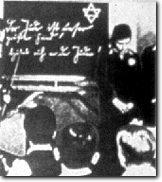
No other than Adolf Hitler, who will always be remembered as ‘the incarnation of absolute evil.’ The man Elie Wiesel of Boston University said ‘thought to reign by selling the soul of his people to the thousand demons of hate and of death.’ His plans were to create a clearly superior people through the elimination of anyone and everything different, through the objectives I mentioned. It was a great plan for the education of his drone population, but they went on to carry out the evils of his cold, black heart. His system inspired masses of people to commit heinous crimes of humanity against another people solely on the basis of their differences.

Good Idea: Educate our children to be the best in the world

Bad Idea: Educate our children to believe others in the world are weaker because they are different

Good Idea: Eliminate feelings of incompetence instill feelings of self-worth and confidence
Bad Idea: Eliminate an entire race because they are different

A system that produces mindless, heartless drones of evil should not be the recipient of any praise whatsoever…but someone’s got to consider the amazing effectiveness of their training. An education can be great, but it must be accompanied by the right reasons. A Jewish survivor said, “"My eyes saw what no person should witness. Gas chambers built by learned engineers. Children poisoned by educated physicians. Infants killed by trained nurses. Women and babies shot and killed by high school and college graduates. So I’m suspicious of education.” If we use our wisdom for evil purposes, if we become magnanimous only to trample underfoot others who we deem as lesser individuals and peoples just for being different, something has gone horribly wrong. “Reading and writing,” continued the survivor, “and spelling and history and arithmetic are important only if they serve to make our students human.”
Sunday, March 22, 2009

The Great Inquisitor

Perhaps some of you have taken the time to read "The Brothers Karamozov." I have not, however this past week I did read the great tale of Book Five known as "The Grand Inquisitor." The book, as many of you may know, is about two brothers--one preparing to be a monk, the other agnostic. In this chapter the agnostic brother, Ivan, tells a story in attempt to paint an ugly picture of the Catholic church. The story poses the question "What if Christ came to earth to during the times of the Spanish Inquisition?" From reading this along with my other knowledge of the inquisition, fostered by Monty Python, among other things, freedom in the Catholic church during the inquisition is actually quite comparable to some of the problems children encounter in the classroom.


The passage that brought this thought to me came from the Inquisitor’s statement about Jesus’ living bread. “They will understand themselves, at last, that freedom and bread enough for all are inconceivable together, for never, never will they be able to share between them.” And while the Inquisitor might be talking about the difficulty of mortal men administering an eternal gospel to their people, we can understand it in an educational context as well. We can allow students to have many freedoms and school, but giving them those freedoms will not allow us to educate all the children. Obviously some students will make choices that will hinder their ability to learn and progress in their studies. The Inquisitor’s answer was to deny freedom, for the benefit of the whole, whereas Christ’s plan (as we who understand the Plan of Salvation understand) gives us freedom to choose, and experience the consequences of sin and error. “Nothing is more seductive for man,” argued the Inquisitor, “than his freedom of conscience, but nothing is a greater cause of suffering.”
And yet we still send our children to these schools of compulsory learning, where we as well were sent, and where we chose to attend after high school. The Inquisitor tells his prisoner that “man is tormented by no greater anxiety than to find some one quickly to whom he can hand over that gift of freedom with which the ill-fated creature is born.” It is because we often make bad decisions, and when we’re sick of feeling those bad decisions we decide that it will feel better if others made those decisions for us. The gospel isn’t as easy as this, for even though we are depicted by anti-Mormon media as conforming self-righteous drones, the truth is that making these decisions is incredibly hard. I haven’t met one member of the church who thinks it’s easy making righteous choices every second of every day, nor one member whose heart doesn’t fill with guilt the moment they do sin.
And that’s why compulsory school works so well for people. We would hate for our children to make poor educational decisions, and we would hate to be made responsible for their poor achievement, so we found a way that everyone is given the same path, and is forced to follow it until they crave it--until “it will save them from the great anxiety and terrible agony the endure at present in making a free decision for themselves,” as the Inquisitor said. Even if we really aren’t sure why we’re doing what we are, why the hoops have been held in certain places, or how we get good grades without learning or putting forth effort (which no one ever really second guesses, but should), we continue to go show up, go through the hoops, fail to learn and put forth minimal effort. “And if it is a mystery, we too have a right to preach a mystery,” said the Inquisitor, “and to teach them that it’s not the free judgment of their hearts, not love that matters, but a mystery which they must follow blindly, even against their own conscience.”
I’m not really sure who the Inquisitor represents in these present days. I want to say Rod Paige, but I won’t. Our system needs a fix, but to give freedom is too much, I believe. Even if it’s against the principles of the gospel, even if spiritual answers are the answers to all--even temporal--problems, even if I don’t like the idea and can criticize it to death, what have we that’s any better? And how do you implement change in an institution so set in its ways? (Like introducing universal health care to the United States--not even worth the work.) Freedom is a good concept, but not as practical as we might wish it were.